
Your energy bill typically consists of various components
-
Energy cost: price you need to pay for the generated electricity
(e.g. fixed price, variable price, dynamic price) -
Energy distribution and transport cost: price you need to pay to transport the generated electricity to your home
(e.g. fixed transport, Time Of Use transport) -
Additional charges (supplements from the government)
-
Taxes
Dynamic Tariffs
Dynamic tariffs are electricity pricing plans where the cost of electricity changes throughout the day (every 15 minutes) based on market conditions, such as supply and demand. Unlike fixed or flat-rate or variable tariffs, which charge the same price per kilowatt-hour (kWh) regardless of the time, dynamic tariffs reflect real-time or near real-time electricity prices.
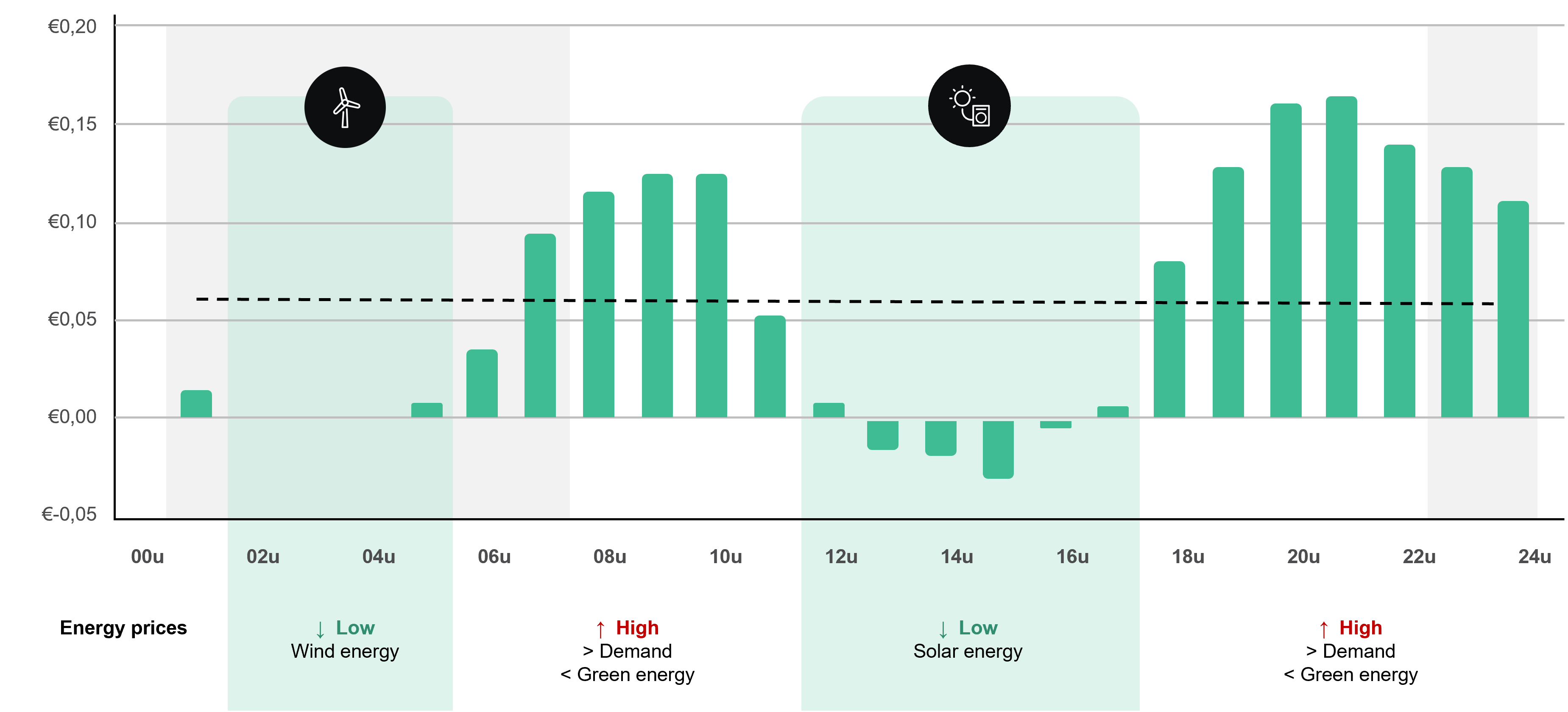
Dynamic tariffs reflect real-time or day-ahead market prices. Prices are often:
-
Low at night, early morning, weekends, and during high renewable production (e.g. sunny or windy days)
-
Higher during weekday evenings and cold winter mornings
So it’s best to use energy when it is cheap and shift your energy consumption as much as possible to those cheapest moments.
Time Of Use distribution tariff
A time of use (TOU) tariff for electricity is a pricing plan, having fixed time slots where the cost of electricity varies depending on the time of day, day of the week, or season
Under a TOU tariff, electricity is usually more expensive during peak demand hours (when the grid is under more stress) and cheaper during off-peak hours (when demand is low).
Time Of Use tariffs reflect the real-use of the grid transport and distribution capabilities:
-
Peak hours with a high price: lots of people using power, e.g. evenings when people come home, cook, use appliances.
-
Off-peak hours with a low price: during the night or afternoon when there is less demand
-
Intermediate hours with a medium price: Transition periods between peak and off-peak.
So it’s best to use energy when it is cheap and shift your energy consumption as much as possible to those cheapest moments.
A dynamic tariff and a Time Of Use tariff reinforce each other: the combination of both tariffs make the off-peak hours even more interesting to consume your energy.
The availability of a Time Of use Tariff depends on the country, electricity supplier and could be mandatory or optional.
Distribution Tariff in Denmark

|
Price (c€/kWh) |
Eco hours |
Medium hours |
Peak hours |
|---|---|---|---|
|
Winter (Oct-Mar) |
1.86 |
5.58 |
16.7 |
|
Summer (Apr-Sept) |
1.86 |
2.78 |
7.25 |
“Tarif Impact” in Belgium - Wallonia

|
|
Heures eco (eco hours) |
Heures medium (medium hours) |
Heures pic (peak hours) |
|---|---|---|---|
|
Price (c€/kWh) |
2.71 |
8.13 |
13.54 |
Plan your energy use automatically
Electrical vehicles (EV) are one of the biggest electricity users in a household. With dynamic pricing and or Time Of Use distribution tariffs, you can schedule charging during super off-peak periods (e.g. at night or in the afternoon). This can cut charging costs by more than 50% compared to fixed rates.
Niko Home Control automatically monitors those dynamic prices and shifts your EV charging to the best moment in time with the lowest cost, taking your energy production and other energy flows in your home into account as well.
Connect your EV as much as possible with your EV charger. Niko Home Control will automatically look for the best moments to charge.
Which devices can you control ?
Currently, only EV chargers are supported.
Battery (dis)charging is coming soon.
Heat pump (boilers) can be boosted twice a day (in the afternoon and at night) via a time program.
For more information about car charger functionality, see https://guide.niko.eu/en/umnhc2/lv/energy-management-of-car-chargers.
For a list of compatible brands, see https://guide.niko.eu/en/connhc2/lv/ev-chargers.